Affiliate link • We may earn a commission
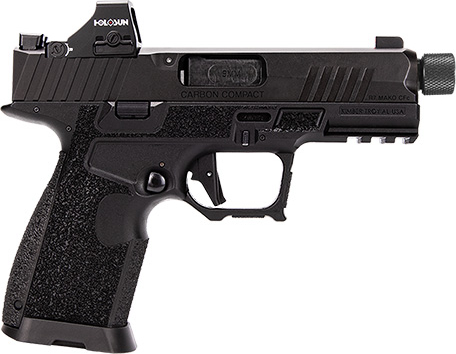
Optic Ready, Molded Grip Stippling, Holosun 407K, Performance Carry Trigger, Threaded Barrel
Kimber’s R7 Mako line began as the company’s entry into the polymer-framed, striker-fired micro-compact market in 2021. The Mako was Kimber’s attempt to marry classic Kimber trigger feel and ergonomics with a modern, optics-ready polymer platform; the original R7 focused on extreme concealability and a flat-faced “Performance Carry” trigger. In 2024 Kimber expanded the family with the R7 Mako Carbon Compact, a larger, higher-capacity variant built around a carbon-fiber–infused frame and offered in optics‑ready and optics‑installed configurations — including factory-fitted Holosun red-dot options and a threaded-barrel TFS variant. The Carbon Compact positions itself as a “stretched micro‑9,” intended to bridge the gap between thin subcompact carry pistols and compact service-size guns.
Where the original R7 was essentially a small, high-capacity micro‑compact, the Carbon Compact is a more deliberate redesign. Kimber’s frame for this model is made from a carbon-fiber‑infused polymer matrix; company materials cited by industry coverage claim a very high tensile strength for the material and Kimber uses the stiffer matrix to support a flared magwell, a deeper trigger undercut and interchangeable backstraps — all intended to improve purchase and reload speed without adding excessive bulk. The slide and barrel remain stainless steel with Kimber’s ferritic nitrocarburizing (FNC) finish; optics cuts are direct‑mount RMSc/Holosun K footprints so many common micro‑red dots fit without adapter plates. Standard Carbon Compact models ship with TruGlo Tritium Pro three‑dot night sights (orange front ring, white rear rings).
The dimensions and hardware choices translate to a gun that feels closer in handling to a compact pistol than a true micro. The threaded TFS variant uses a 4.42‑inch extended, 1/2‑28‑TPI threaded barrel, while non‑threaded Carbon Compacts use a ~3.9‑inch barrel. The TFS OI (Optics Included) spec that many dealers list combines the threaded barrel with an installed Holosun HS407K X2 on Kimber’s direct‑mount cut. Empty weights reported for the threaded Carbon Compact are in the mid‑20 ounce range (around 25.8 oz empty for the TFS OI), with loaded weights rising accordingly when a Holosun is installed. Those proportions give the pistol a steadier, less snappy feel than smaller micro‑compacts while still remaining concealable.
Independent reviewers who ran extended live‑fire evaluations report that the Carbon Compact is a predictable, accurate shooter for its class. Range testing in several published reviews and shoot‑tests found the Carbon Compact to group tightly at common defensive distances (7–15 yards) and to display strong, repeatable point‑of‑aim performance with both the iron‑sight setup and factory‑installed 6‑MOA Holosun options. In controlled testing the Performance Carry trigger typically averaged in the low‑to‑mid 4–5‑pound range depending on measurement method; testers describe the shoe as a flat, rising‑resistance pull with a somewhat “rolling” break and an audible, tactile reset.
Reliability in published tests was encouraging: reviewers who ran several hundred rounds (and, in one extended test, roughly 500 rounds including suppressed fire) reported no malfunctions and noted that the longer slide and barrel geometry of the Carbon Compact improved feeding and recoil control versus the smaller original R7. Shooters repeatedly noted the carbon‑infused frame’s stiffness as a positive contributor to perceived solidity and recoil management; with a higher grip and a flared magwell the gun tends to track naturally and return to target quickly for follow‑up shots. That said, some testers remarked that slide serrations are relatively shallow and aftermarket holster and accessory support remains limited compared with more established compact platforms.
It is also worth noting that the broader R7 family experienced a factory recall on certain early R7 units (not specific to the Carbon Compact introduced in 2024): Kimber issued a voluntary recall for a firing‑pin safety block on some R7 pistols built and shipped in early 2022, offering remediation for affected serial numbers. Prospective or current owners should confirm any service history or recall status for their specific serial number with the manufacturer.
Given its footprint, capacity and feature set, the Carbon Compact is aimed squarely at the everyday‑carry market for those who want more capacity and controllability than the smallest micro‑compacts without sacrificing concealability. It is well suited for defensive carry, particularly for shooters who prefer a slightly larger grip and the option to carry with a micro‑red‑dot installed from the factory. The availability of a threaded barrel TFS variant also makes it viable for suppressed shooting and for shooters who anticipate regular dry‑fire and training with a micro optic.
On the flip side, the Carbon Compact’s “stretched micro” dimensions put it into a different handling category than ultra‑thin pistols: it is thicker and longer than the lightest AIWB options, and some carry platforms or holster cuts designed for the original R7 will not fit the Carbon Compact. Aftermarket holster and accessory availability lags behind dominant compact offerings (such as Springfield’s Hellcat Pro and the SIG P365 variants), which can be a downside for owners who want a broad ecosystem of aftermarket upgrades. While most published testing shows good out‑of‑the‑box reliability, Kimber’s mixed historical reputation among some buyers means that buyers should inspect and, if necessary, work with Kimber to verify service and serial‑specific status.
The R7 Mako Carbon Compact enters a crowded but lucrative segment: “compact‑sized” carry pistols that retain higher magazine capacity and optics readiness. Reviewers and press compare it directly to the stretched micro platforms — SIG’s P365 Fuse/X‑Macro family and Springfield’s Hellcat Pro among them — and place Kimber’s offering as competitive on ergonomics and features. Where Kimber tries to differentiate is by packing a more substantial, ergonomically refined grip and a carbon‑infused frame into an optics‑friendly package, plus the option for a threaded barrel and factory‑installed Holosun optics. For buyers who prioritize a comfortable grip, a good factory sighting system and a direct‑mount optic option, the Carbon Compact offers a lot of kit relative to many peers. Where it lags is in aftermarket support and the residual reputational baggage that some consumers attach to Kimber’s broader product lines.
In short, the Kimber R7 Mako Carbon Compact is Kimber’s answer to shooters who wanted a more capable, less “snappy” Mako: larger grip, higher capacity and an optics‑centric design that competes well in the modern compact carry market. Reviewers who spent time with the gun generally praised its ergonomics, accuracy and out‑of‑the‑box reliability, while noting the usual tradeoffs of holster selection and aftermarket depth that come with a newer platform.