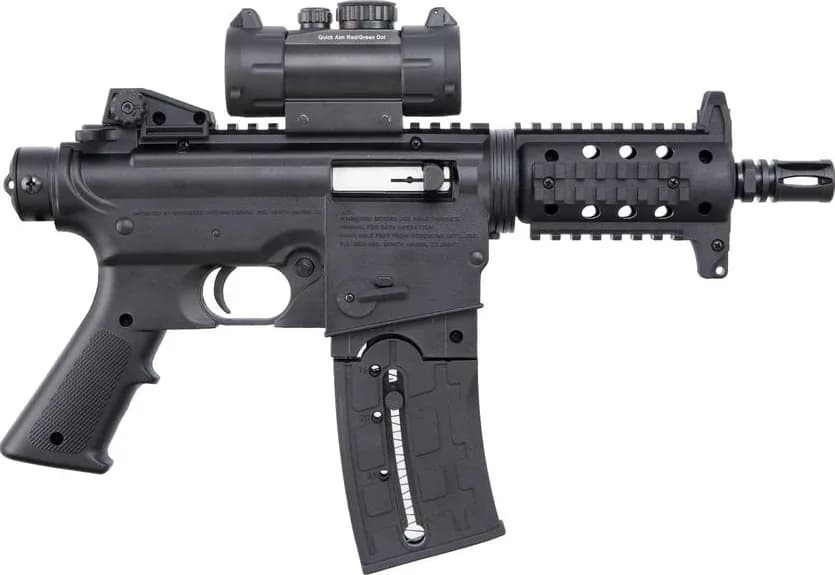
Top Rail, Short Quad Rail Forend, Sling Points, UTG Red Dot Sight Included, Davidson's Exclusive
The Mossberg 715P FlatTop autoloading pistol arrived as part of Mossberg’s effort to cash in on the popular “AR-style” rimfire market. The pistol variant was introduced in 2014 as a compact, pistol-shaped offshoot of Mossberg’s 715T/702 Plinkster family, designed to offer an AR-like appearance and ergonomics while using the inexpensive .22 Long Rifle cartridge. Early press and hands-on reviews framed the model as a low-cost trainer and plinker that mirrored the look of an AR pistol without sharing AR internal parts or controls.
Mossberg positioned the 715P alongside the company’s existing rimfire offerings as a tactical-styled option: it shipped with a polymer “shell” that wraps the conventional blowback .22 receiver, a flattop Picatinny rail for optics, a quad-style forend for accessories, and a high-capacity magazine option. Over the years Mossberg produced a number of variants and combo packages (some bundled with red‑dot optics), which helped the line reach a broad segment of buyers seeking a visually familiar AR platform at a lower cost and with very light recoil.
Under the tactical shell, the 715P is mechanically much closer to the long-running Mossberg 702 Plinkster than to any AR‑15. The 715P uses a blowback-operated .22 LR action, with a molded polymer exterior that reproduces AR features — A2-style grip, faux charging handle, and a quad rail forend — while enclosing a standard rimfire bolt and magazine well. The company owner’s manual lays out the simple blowback cycle, crossbolt safety, and recommended ammunition types; it also describes the magazine installation and the non‑AR-style operating handle used to retract the bolt.
The pistol’s six‑inch blued barrel (1:16" twist on many builds) and A2-style muzzle device, combined with a 25‑round detachable magazine in most unrestricted configurations, give the 715P its characteristic balance and silhouette. The molded shell makes the receiver largely non‑serviceable in the AR sense: controls such as the safety are crossbolt-style rather than a receiver-mounted selector, and the “charging handle” is cosmetic while an operating handle on the right works the bolt. Field stripping for full disassembly is possible but more involved than many purpose‑built rimfire pistols because of the clamshell construction. These choices trade true parts commonality and modularity for a distinctive look and low factory cost.
Ergonomically, the 715P will feel familiar to shooters who like AR pistol grips and flattop optics. The molded grip and handguard offer decent purchase for a rimfire; the weight and length deliver a steady sight picture for a pistol, but because the firearm is not a true AR in function, muscle‑memory transfer to a centerfire AR is limited.
Published hands‑on testing and range reports show the 715P can be an accurate, enjoyable plinker in the right hands. One early review recorded sub‑minute groups at 25 yards with a quality .22 load and praised the stock trigger as having an acceptable break and modest overtravel for a budget rimfire. At the same time, reviewers noted sight adjustments could require significant windage correction out of the box, and that co‑witnessing optics with the factory sights was practical thanks to the Picatinny rail.
User experience is less uniform: forums and user threads document a range of real‑world reliability reports. Some owners report long, trouble‑free sessions and good accuracy for plinking and training, while others have encountered feed and extraction problems common to inexpensive blowback rimfires — short‑stroking, failures to extract, and magazine release or fit issues. These mixed reports suggest that, as with many budget rimfire designs, ammunition choice, magazine condition, and routine maintenance materially affect reliability. Presenting the full spectrum of shooter feedback gives a clearer picture than any single test.
Durability for the 715P should be judged against its price and intended role: it is not a precision target arm or a heavy‑use defensive duty gun, but many owners find it durable enough for casual range use and training when fed suitable .22 LR ammunition and cared for properly.
The 715P’s strengths are obvious: low recoil, inexpensive ammunition, optics friendliness, and the look and basic handling cues of an AR‑style pistol. Those features make it suited to recreational plinking, inexpensive marksmanship practice, and introducing new shooters to semi‑automatic platforms without the expense and noise of centerfire rounds. Its 25‑round magazine capacity and accessory rails also appeal to backyard shooters and informal tactical‑style training scenarios.
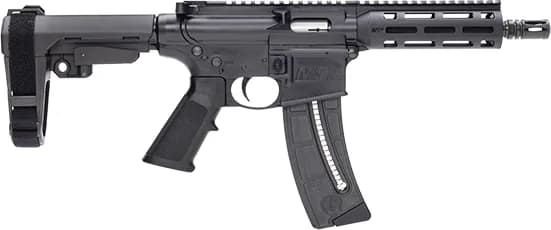
However, the 715P has clear limitations. It is not a substitute for a quality centerfire defensive firearm; the .22 LR cartridge’s terminal performance and the pistol’s design preclude serious defensive carry claims beyond last‑resort scenarios. Because the internal layout and controls do not mirror an AR‑15’s manual‑of‑arms exactly, it provides less direct skill transfer for AR shooters than purpose‑built trainer platforms that replicate controls (for example, the M&P15‑22 family). Additionally, reliability with rimfire ammunition can be more finicky than with centerfire designs, so the 715P is best suited to controlled range environments and casual use rather than intense, high‑round‑count training without attention to ammunition and magazines.
The 715P occupies the budget end of the AR‑style rimfire pistol market: it competes on price, aesthetic, and the fun‑factor more than on parts interchangeability or class‑leading reliability. Peer products aimed at the same niche include dedicated .22 AR trainers and tactical‑style rimfire pistols from established rimfire specialists; among those, purpose‑built trainers (such as the Smith & Wesson M&P15‑22 family and Ruger’s rimfire platforms) are generally seen as offering better AR‑control fidelity, broader aftermarket support, and stronger track records for reliability — at a higher cost. Buyers seeking the lowest cost AR look‑alike or a novelty tactical plinker often find value in the 715P, while those prioritizing direct parts commonality and flawless reliability typically lean toward the higher‑end, trainer‑focused alternatives.
Market listings and sales history show the 715P circulating both as standalone pistols and in occasional optic combos; resale values tend to reflect its budget positioning and the varied condition and accessory sets that appear on the used market. Given that variability, prospective buyers and reviewers generally evaluate the 715P on personal criteria — whether the emphasis is on price, looks, plinking accuracy, or parts compatibility — and weigh the tradeoffs accordingly.
In short, the Mossberg 715P FlatTop is a competent, inexpensive option for shooters who want a lightweight, fun .22 LR pistol with tactical styling and an optics rail. Its design and engineering make it a solid plinker and a cheap practice tool, but potential owners should balance that against the known limitations of budget rimfire blowback designs and the availability of purpose‑built trainers if their priorities lie elsewhere.
Start with a practical guide if you want a faster way to narrow the field before comparing specific models.
Learn how to choose the right handgun for home defense based on safety, ease of use, and practical everyday considerations.
Read guideBudget-minded buyersLearn how to find a reliable handgun under $500 without wasting money or compromising on quality.
Read guideComparison-focused shoppersA practical guide to comparing handguns the right way: what actually matters, what to ignore, and how to use comparison tools effectively.
Read guide